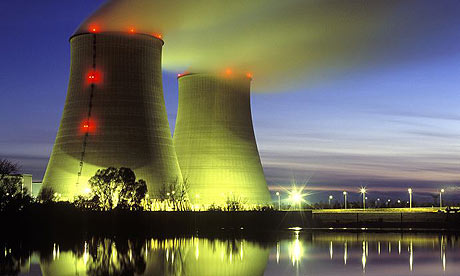
"My speech is on Nuclear Energy. Now, half of you just fell asleep; but let me assure you this speech on nuclear energy will be the bomb." This would be an opening to this incredibly awesome speech for which the outline is available on this blog for a small price.
This speech outline allows you to view various facts and figures about nuclear energy and allows you to formulate your own polished speech based on these already present solid facts without having to do more than verify the information.
This is advantageous over Wikipedia and other sources, as it is a compilation of facts strung together in a logical way that would allow a speech or a discussion to naturally follow. In other words, it's a collection of facts that will have the opposition shaking in their lead-lined bunkers.
Man 1--pro-nuclear energy with my speech's facts
Man 2--anti-nuclear energy
Man 1, "Nuclear Energy is the bomb! We should use it."
Man 2, "Nuclear Energy is dangerous and kills people like what happened in the Fukushima Disaster, costs a lot of money, and is environmentally irresponsible."
Man 1, "Nuclear Energy is quite safe, actually, Fukushima was hit by a 9.0 earthquake and a tsunami, I would like to see any power plant okay after such an incident. At the very least, we learned an obvious lesson: that we shouldn't build nuclear power plants along fault lines, oceans, or by cities for that matter. Many problems that the human race has faced when building nuclear power plants come from a lack of practical planning, poor engineering, or human malpractice and indifference."
Man 2, "Solar panels and Wind farms are still better, since they have little environmental consequences."
Man 1, "Well, it takes 1200 windmills to equal the electrical output of one nuclear power plant, or 20 square miles of solar panels. These would obviously have a much larger environmental effect than one nuclear power plant would. We can therefore see that these so called 'green-energies' are more environmentally irresponsible than nuclear energy. They would obviously destroy much more of the local habitat."
Man 2, "I don't believe you."
Man 1, "Here are my sources."
Man 2, "Ha! Wikipedia is on here! Don't you know Wikipedia is often wrong because it can be modified by the
unwashed masses?"
Man 1, "Actually, Wikipedia has an error rate of 4 errors per page as opposed to the Encyclopedia Britannica's 3 errors per page. The Encyclopedia Britannica can only be altered by professionals even so there really isn't a notable difference."
Man 2, "Well, you still didn't address the cost issue...."
Man 1, "Okay then, were to begin with someone as deprived of knowledge as you evidently are? Most of the cost of nuclear energy comes from the actual creation and decommissioning of the plant itself. The decommissioning can cost as much as 5.6 billion dollars. The creation somewhere around the same. To create the plant, you will have to take out a loan and the interest with all of the creation and decommissioning costs combined will probably be about 17 billion dollars."
Man 2, "Wow! That's a ton of money! Now it makes sense why there aren't any nuclear power plants."
Man 1, "Wait, I'm not finished!
We still have to find how much money this power plant will make! The plant is designed to last roughly 40 years though they often last for a much longer period of time. The uranium costs very little so we will mostly disregard that. Now according to the National Government the average output of energy of a Nuclear Power plant is 12.2 billion KwH a year. According to Rocky Mountain power, the Utah cost is 8.8 cents per KwH for an average Utah home. This is much lower than the 12 cents per KwH national average. We take the 12.2 billion KwH and multiply it by 8.8 cents per KwH and then divide by 100 to get it to dollars and we get an answer around 1.076 billion dollars a year. We then, multiply that number by the 40 years the plant should last and we end up with around
43 billion dollars gross income. We subtract the 17 billion for creating and tearing down the plant and end up with
26 billion dollars left to cover workers, uranium, and maintenance. This covers these costs easily and leaves you, presumably the CEO, with a tidy sum of money. The only thing that could screw this up is a 30% tax on the gross 43 billion dollar supposed revenue. But, the progressive tax system is another thing we will deal with later."
Man 2, "Wow, I didn't follow that math at all."
Man 1, "I will draw up a formula."
(40 Years*((8.8 cents/KwH*12,200,000,000 KwH)/100))-$17,000,000,000=
$26,000,000,000
There we go. It's obvious that nuclear energy means more jobs, cleaner energy, cheaper energy, and basically never-ending energy."
Man 2, "I don't trust you greedy corporations. I will not support that no matter what logical sense you throw at me. I refuse to believe you."
Man 1, "Live in ignorance then. But, I choose to keep moving forward and create a future with clean, renewable, cheap, and sensible energy."
_________________________________________________________________________________
Sources:
"CASEnergy Coalition." Clean –. N.p., n.d. Web. 10
Nov. 2012. <http://casenergy.org/nuclear-energy/why-nuclear/clean/>.
David, Schlissel, and Bruce, Biewald. Nuclear Power Plant Construction Costs.
Synapse Energy Economics, Inc., July 2008. Web. 10 Nov. 2012.
<http://www.synapse-energy.com/Downloads/SynapsePaper.2008-07.0.Nuclear-Plant-Construction-Costs.A0022.pdf>.
Jason, Morgan. "Comparing Energy Costs of
Nuclear, Coal, Gas, Wind and Solar." Nuclear Fissionary. N.p., n.d. Web. 10 Nov. 2012. <http://nuclearfissionary.com/2010/04/02/comparing-energy-costs-of-nuclear-coal-gas-wind-and-solar/>.
"How Much Electricity Does a Typical Nuclear
Power Plant Generate?" U.S.
Energy Information Administration. EIA, n.d. Web. 10 Nov. 2012. <http://www.eia.gov/tools/faqs/faq.cfm?id=104>.
"Residential Price Comparison." Residential Price Comparison.
Rocky Mountain Power, n.d. Web. 10 Nov. 2012.
<http://www.rockymountainpower.net/about/rar/rpc.html>.
Wikipedia contributors. "2011 Tōhoku
earthquake and tsunami." Wikipedia,
The Free Encyclopedia. Wikipedia, The Free Encyclopedia, 9 Nov. 2012. Web. 10 Nov.
2012
Wikipedia contributors. "Nuclear
power." Wikipedia, The
Free Encyclopedia. Wikipedia, The Free Encyclopedia, 18 Oct. 2012. Web. 10 Nov.
2012.
_________________________________________________________________________________
This dialogue is an example of a debate that could occur while using my facts, many of which are demonstrated throughout this dialogue.
It should be noted that the speech is not written out, but is rather a very in-depth speech outline providing many facts as well as a large list of sources at the bottom which contains five Wikipedia references among others. The speech, including sources, is
4 pages in Microsoft Office Word, Times New Roman size 12 font except for the sources which are 9 point font.
Many of the numbers in it are subject to change due to economical factors and I take no responsibility if they change. Check your data before use!
It should be noted I have given the speech before and turned in this speech outline, and it should not be used for scholarly purposes due to plagiarism and originality issues. The sources however are still good and if you check your information before using facts it should be fine. It is good for talking points and research that will further the cause of nuclear energy in the United States. This speech outline is intended to convince people of the goodness of nuclear energy by raising awareness of its various aspects.
Let's make Nuclear Energy in the United States, and Utah specifically, a priority goal
within the next 10 years.
Thank you.